Five steps
that close every day.
The plan sets the direction. Your daily form decides what today's session looks like. Here is what happens in between.
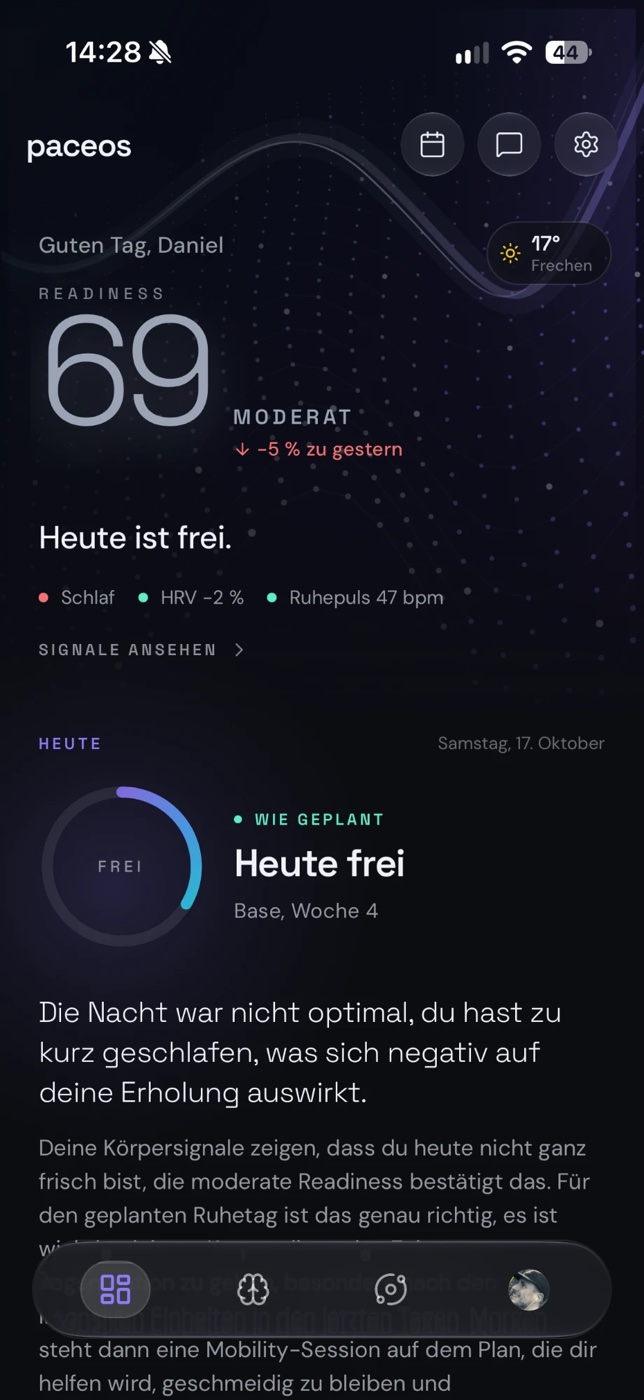
How does paceos decide? Every night your watch delivers sleep duration, HRV, resting heart rate and breathing rate. paceos compares each value with your own average over the last 7 days, outliers removed. The result is a readiness in four levels: recovery needed, moderate, well recovered, optimal. Together with the load of the last 48 hours and today's planned session, that becomes a decision: as planned, reduced, moved or easy. A transparent rule engine makes the decision, not the AI. The AI explains it to you.
Your watch, your night
Garmin, COROS or Apple Watch deliver sleep, HRV, resting heart rate and breathing rate. Automatically, while you sleep. Runs come from any source, including Polar, Zepp and Strava.
Your readiness
Every value only counts compared with yourself. An HRV of 45 can be an alarm for you or perfectly normal. You see the value, the level and a one-sentence explanation.
The decision
Before you are awake, it is settled what makes sense today: session as planned, volume reduced, intensity out or a swap with an easy day. With reasons and one tap back.
To the watch
The session is on your watch, with pace and heart-rate ranges per segment. You press start. After the run, the recording comes back into the app.
Your runner model
paceos compares plan and run, asks how it felt, and checks the next morning whether the decision worked. That is how it becomes more your coach every day.
Your baseline,
not the average.
Most apps rate your HRV against tables for age and sex. paceos rates it against you: against your mean of the last 7 days, outliers removed. That is why paceos needs about a week before the first readiness appears, and gets more precise with every night after that.
Several values clearly below your baseline. Easy or off today, the hard stuff waits.
One value below baseline or high load in the last 48 hours. Volume down, stimulus stays.
Everything within your baseline. Your plan, as intended.
Values above baseline and little load. An offer for more, not an obligation.
What paceos learns about you.
From up to 120 days of your runs and nights. Every metric carries a confidence label: preliminary, reliable or established. Example values:
Hours after a long run until HRV and resting heart rate are back within your baseline. Separate per session type.
How much more load than usual you tolerate before readiness or performance tip.
Running efficiency after nights under 6.5 hours compared with nights of 7 hours or more.
Highest weekly volume you have tolerated without a dip. Beyond this, paceos gets careful.
HRV tolerance
How much your HRV may fluctuate before it means something for you.
Two hard days
Whether you handle two hard sessions in a row or whether that reliably costs you a day.
Response to adjustments
Whether reduced sessions really bring fresher values the next day for you. If not, paceos adjusts more cautiously.
Built on sports science,
not on gut feeling.
We do not invent formulas. We apply established models consistently to your data.
Load and form
Training load as an impulse-response model (Banister): chronic load, acute load and their ratio (ACWR) show fitness, fatigue and form as a trend.
Polarised training
Most training stays easy, few sessions are hard (after Seiler). Four of six easy runs too fast? paceos tells you.
Pace zones
Threshold pace and five pace zones are derived from your real runs (VDOT logic after Daniels) and updated after every race.
Garmin, COROS, Wahoo, Apple Watch.
The session lands where you already look.
paceos does not replace your watch. It uses it.
Workouts to your watch
The finished session with pace and heart-rate targets is on your wrist before you lace up.
Garmin · COROS · Wahoo · Apple Watch
Night and recovery
Sleep, HRV, resting heart rate and breathing rate arrive automatically while you sleep.
Garmin · COROS · Apple Health (Apple Watch)
Import your runs
Every run flows back into the plan and your runner model, whatever you recorded it with.
Polar · Zepp · Strava · all of the above
As of October 2026. Apple Watch receives structured workouts from iOS 17.
Your watch already measures.
Let paceos decide.
Try it free for 7 days, no payment details needed. Then €59.99 per year or €1.99 per week. Cancel anytime.
For iPhone running iOS 15.1 or later, with an Apple Watch app. All values on this page are examples. paceos does not replace medical advice. If you are in pain, ill or unsure, your body and your doctor decide.